TTA is the abbreviation for tibial tuberosity advancement. The TTA is among the newer techniques for cranial cruciate ligament repair of the canine stifle, making its appearance roughly 10 years ago. The TTA technique was developed in 2002 at the University of Zurich, and, biomechanically speaking, the procedure is very similar to the TPLO, without carrying many of the risks. In fact, the TTA is a simpler procedure for veterinary surgeons to perform than the tibial plateau leveling osteotomy, or TPLO, and works to correct the injured stifle without overcorrecting the angle – as TPLO often does.
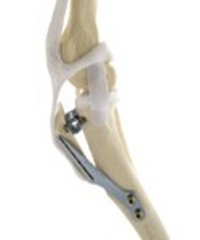
During the procedure, an incision about 4 to 6 inches will be made along the dog’s stifle to provide the surgeon access to the knee tissues. The torn/ruptured cranial cruciate ligament, or CCL, is completely removed and the meniscus is examined. The veterinary surgeon will determine at the time of surgery the extent to which the meniscus has sustained damage and will work to remove the injured tissue. The doctor will take care to only remove meniscal tissue that is damaged, as dogs with some intact, healthy meniscus tend to do better long-term than dogs receiving a complete meniscectomy.
A transverse osteotomy is then performed just behind the tibial tuberosity (a non-weight-bearing part of the knee), which creates a groove in the bone, allowing the tibia to be advanced to its new position. The tibial tuberosity is then advanced to achieve a perpendicular relationship between the tibial plateau slope and patellar tendon, resulting in a stable joint. Examination of the stifle with a-ray radiography prior to surgery will make sure the surgeon has the proper size implants available for the procedure, and the advanced tibial tuberosity is held in place with titanium implants. Lastly, a bone graft is placed into the area of the osteotomy to stimulate healing and the incision is closed with sutures.
My 4 year old german Shorthair (approx. 70 lbs) has bilateral torn ACL’s. An ortho vet is suggesting surgery and has recommended TTA over TPLO, mainly because he feels both knees can be repaired simultaneously using TTA. He has been very careful not to “sell an operation” and has explained all of our options, including traditional surgeries and even no surgery.
I am inclined to take his advice on the TTA though. What does anybody else think?
My dog, Diego, just had the same thing happen and that is what the ortho vet is saying at Cornell Veterinary Hospital. However, I just read about TTL, so I’m going to also look into that.
Good luck
Well, I have a similar, but worse, situation with my 3 yr old girl Kendra. She is a 170 lb English Mastiff. Overnight, she woke up nand couldn’t walk on her front leg…she literally would not get up off of the floor for two days. The Vet came to the house and found no positive signs of injury. We put her on pain meds and she seemed to be doing ok with that, in fact, too good. 6 days after the front leg limp, she tore her right hind leg ACL, we believe to be a complete tear. That caused her to fall and tear the left hind leg. Now she is down to one good front leg. Xrays show osteoarthritis in the front elbows, however, this dog has been the picture of health, super athletic and not overweight. Two vets at the same hospital recommend TPLO. We are going to Cornell tomorrow for a second opinion. TPLO is a dramatic surgery. I don’t think she would be able to handle the rehab. I have just read here about TTA and Traditional repair. I am also thinking of waiting longer to decide upon surgery. She needs to get some strength back in the front to be able to handle any surgery at all. Our friends had a 195 lb Mastiff with the same tear. They did the imbrication (or fishing wire type surgery). Years later, their dog had the second knee done. He went on to be 13 1/2 yrs old. They said with the procedure they did, he had to use the leg to put some weight on it right away, due to his size. They cautiously walked him for 6 months each time. Kendra is in a worse situation, but I am thinking about all options. I am leaning toward the least invasive to buy her more healing time and if that doesn’t work down the road, step it up to TPLO, etc. We have not had an MRI done yet, that will be next. My Vet can’t understand how a dog with 3 years of no limping and great health can end up in this state. I can’t understand how arthritis can have an overnight onset, as she has had in the front leg. I am thinking there must be more to this and we haven’t dug deep enough.
The Bilateral TTA was done on Friday and I brought her home on Monday. She is able to sling walk. One incision is already healed and the bandage will come off today. She needs oral pain meds, heat applications and 2 or 3 5 minute walks per day. If I had this to do over again, for both legs in need, I would make the same choice. I half think I would choose the same procedure for one leg. The work begins, but with Kendra at 170 lbs, I am thankful that she can stand and walk while healing. That was critical for us. I have to figure out something for her front leg arthritis though. She really struggles with it. We plan to go for the Physical Therapy plan at Cornell…it is a ten day program, but it is vital that it be done. We want her to return to her normal routine…well , maybe a bit less running and jumping.
1 week after surgery and Kendra has done amazingly well. She is eating right, one incision healed, one to go, she wants to walk 4 times per day….what a recovery she is making. She is so strong that it takes two of us to control her urge to run!! I am so pleased with her progress. I have been heat treating her front leg, to see if it helps with the initial injury, which is believed to be arthritis. I have her on Dasuquin and am looking into a natural remedy for her arthritis. Hyaluronic acid, I see is being used and Rhus Tox is another. I will keep after all issues so that she can better perform when she goes to physical therapy.
Hello Wendy, I just read your post about Kendra as I am learning tonight about CCL injury. Today our VET believes that Toodles our 21 month female mastiff pit mix, has injured her right perhaps both of her CCL’s. Next Tuesday we see the surgeon our vet referred us too. How is Kendra doing? I am looking at the various options.and though money is very tight around here in part since we have 11 dogs(various breeds), I’ll figure a way to give her the best options. Would you say the TTA was your best choice? Toodles is 95 lbs and had been very active. Being so young I surely want the best outcome. Thank you, Scott.
Wendy,
Please keep us up to date as I have a Rotty who is in need of surgery now, we are leaning towards going with the TTA. I am trying to learn as much as I can before deciding.
Our 55 lb. 4 year old queensland heeler was diagnosed with cranial cruciate ligament degeneration on both hind legs. My husband and I took him to our local orthopedic surgeon and he discussed various options with us. After doing a bunch of research online, and getting second opinions, we decided to go with the TTA. It’s a much less invasive procedure than the TPLO, with just as good results.
The vet decided to do one leg at a time, to reduce the risk of re-injury, and he had his first one today. So far, so good. He is really sleepy as he is on a lot of pain meds. Physical therapy consists of taking him for two walks a day for 2 1/2 minutes each, and really restricting his movement. We’ll build up from there.
In 6 weeks, it’s on to the other knee.
My 94 lb german shepherd (Zack) had a parital tear on his right hind leg which was also causing the left rear leg to piviot when he walked. He is not over weight but injured it while running hard and then suddenly stopping on wet grass. The surgeon performed the TTA Wed with great results. He was home the next day, and was weight bearing on the repaired knee after the surgery. Thank goodness he is “crate trained” and has been sleeping most of the day with short walks outside to relieve himself. The piviot in the left leg is gone, and now looks to be a normal gait although still a little shaky at times on the repaired kee. I am so relieved that we went the TTA route from everything that I have read. There was very little damage overall to his knee other then the partial tear. No telling what other problems zack could have encountered had we waited any longer on the surgery. A good chance he could have injured the other CCL if not taken care of. Of course there is always the posibility he could tear the other one sometime down the road. Some reports say that it does happen in about 50% of dogs. Now for the 3-4 months of recovery which will be hard on Zack since he has a high energy level and drive. I will post again in a month or two, and report his progress.
Hey all you guys, its been 6-8 months since the last posts here. How did everybody make out? My 6 y/o pit mix is going for the surgery next week. Needless to say, Im a little uneasy about it. Please update
My 4 year old Sarplaninac tore her cruciate ligament and had a TTA which went really well. She is now 4 post surgery and seems to be OK. I noticed today that she is limping on the leg that had the surgery and am wondering if it is possible to injure the cruciate ligament a second time? Any thoughts would be appreciated. Thanks. Tonya
Hi everyone, I have a 3 year old mix breed that’s about 45lb and she tore both cruciates at 1 year old. She had a double TTA done at 2 years old and she seemed to recover great. At 6 months post op she began limping horribly on one of her legs and even sometimes not using it at all. The vet has checked so many things and can’t find the problem. Just wondering if anyone else has had a similar problem and what the result was. Thanks. Jen
My 5 1/2 year old golden retriever had TTA surgery on her left knee in April and the same surgery on her right knee 3 weeks ago. She is doing amazingly well. Definitely notice that she is doing better with the 2nd surgery than the 1st, she wants to do a lot more than she should so it makes my job harder to control her. Her surgeon says that she probably won’t be able to play ball until Spring but I am happy that she is walking so much better than she was before her 1st surgery. She is also on a restricted diet until she can start walking at 8 weeks after surgery. If there is anyone that is looking at TTA for their furry kid, I recommend it as long as you have a vet that you feel comfortable with in performing the procedure.
Erin, how is your golden doing? My 1 1/2 year old mutt had her first TTA 4 weeks ago and seems to be doing awesome. Once it’s healed, we will be doing her other leg. How long until yours was able to run and be “free” again. My girl is going stir crazy! But, so far everything else is great. She’s actually walking more on her surgery leg than she is on her one that still needs surgery. I’m hoping that doesn’t cause damage to her leg already operated on. The vet doesn’t seem too concerned, but, I’m a worried momma 🙂
Considering a bi-lateral TTA surgery for my 5 1/2 yr old Wheaten Terrier rear legs. One surgeon suggests both and says he only does this on rare cases and she is a candidate for it. Another vet says she will not do both. I am so confused. Both knees are horrible. Just afraid of time under Anethesia and healing.
[…] rather changes the bone structure so that the ligament is no longer necessary for stabilization. A linear cut is made along the length of the front line of the tibia. The cut bone is moved forward and a bone spacer is […]