my 4 year old g.s.d. had successful tightrope surgery 90 days ago. complicating matters, both menisci were torn and removed during procedure. still does a little toe dragging when tired but is 90% back. we will likely cut back on the agility trials and flippy-flopper jumping in favor of more linear and less stressful excercise. dr paul henrich, tranquility vet clinic in sussex county, nj did an amazing job. apparently, he has modified or improved dr jamie cook’s procedure to allow the operation to be successful on larger, athletic dogs who may previously have only been candidates for t.p.l.o. “why would you break a bone to repair a ligament ?”
I have a 17mos old Boerboel Mastiff that has a torn ccl and have been researching possible alternatives to TPLO – looking for ortho surgeons in the Seattle area that have used this procedure – any ideas?
tightrope modified for active, 90 lb. 5 yr yound g.s.d. was successful for owner and canine. when she is whomped, drags the toe downhill a little. why break a bone (tplo) to repair a ligament?
Kate had to have the tightrope removed because it broke inside the bone. It apparently rubbed against a jagged edge and frayed. She was never good from the “get go” she always had a limp. Other people that I have talked to they went with the TPLO and their dogs did fine. Kate had the TPLO last week and already seems to be doing better quicker than when she had the tightrope procedure.
I, too, have a Boerboel Mastiff. Saturday, she began to walk with a limp. My husband took her to the vet this morning and he was advised that she tore her CCL. What did you end up doing for your dog, how did it go, and how much did it end up costing you??
In response to Bev’s post…I live in Bellingham, WA. My 3 year old Boxer just underwent TPLO Surgery. He is into day 7 of his recovery. I did not know about Tightrope procedure prior to his TPLO surgery. My neighbor told me about the Tightrope procedure and recommended his Vetinarian Dr. Ed Sullivan of Bellingham Veterinary, 720 Virginia Street, Bellingham, WA 98225 phone number is: (360) 734-0720.
I spoke to Dr. Sullivan and he gave me some great information. If you are unable to find a Vet in your area who is familiar with the tightrope procedure, I would highly recommend Dr. Sullivan.
I am in Kansas City, MO and My four year old black lab has had a TPLO out at Kansas State University and turned out ok but it was a long road to recovery and still has been. University of Missouri does the tightrope surgery and it is suppose to be better for them and a shorter recovery time.
My dog is in day 10 of his recovery from tightrope surgery. At first he was weight bearing and now he wont put any weight on it all all. Can you tell me how your dog progressed? When was he weight bearing?
Sharon,
I’m sure you already have discovered that the procedure has failed. I have a 70lbs golden retriever who had the tightrope procedure. She never seemed walk without a limp. At approximately 5 months she got up from lying and wasn’t able to bear weight. Now she is scheduled for the TPLO surgery. Not only did the tightrope fail, it also caused her patella tendon to tear.
Our Newfie had TPLO on her right knee last year and it’s been a long recovery for her. Her left knee now needs surgery and someone suggested the tightrope option instead of TPLO. What are your suggestions?
I did get your reply Susan. Sorry it took so long to get back. We actually have been in ‘conservative mangagement’ mode with our Newfie. We haven’t had to do any type of surgery at all for the left leg (keep fingers crossed. Our vet has her on glucosamine and anti inflamatories. The warmer weather I think also has helped improve her movement as well as what we have her on. We have the money for the TPLO, we just would rather something less invasive.. but it doesn’t sound like there is anything for her weight and size other than TPLO. The TPLO we did on her right knee was good, but she was already so messed up before the surgery her little feet bones are crooked so she walks funny even after the surgery. Here’s hoping for the best and we’ll see where we get!
Its been 3 weeks and 2 days after Jaspers tightrope surgery. He is walking on his leg slowly. Its 12 weeks just like the TPLO before he is really functional. It cost us $1800. Plus meds which ended up being more like $2500 and we are still going up on the price.
I heard the TPLO was more successful, but more evasive. More of a guarantee for your money. I would probably due the TPLO if I had to do it over again. Too much insecurity and worry.
Jasper is walking with a strong limp. But the personal pressure to me of the scar tissue healing and the muscle securing the leg is too scary. The rest of his life anything could reinjure it. There isn’t much muscle on his back leg and the security is minimal. Tightrope reminds me of orthoscopic surgery with two pieces of stretchy sewing fabric to secure it. Sometimes orthoscopic is good enough.
Its only been 3 weeks. Jasper is walking on all 4 legs 90% of the time. He is happy and on no pain meds or anti-inflammatories. He is in a large pen in the house and leash walked everywhere for the next 9 more weeks.
A positive note for tightrope. It didn’t take much to severe Jaspers ACL, so the knee doesn’t have to be Fort Knox secure for the dog to live a happy life.
So far so good. He is walking.
Hi Sharon – Joey (my Boerboel Mastiff) had the TPLO on her left knee in May and recovery went very well. Then she ruptured her right CCL in Nov and now has passed the 3 mos recovery and is also doing very well. Found a wonderful surgical clinic in north Seattle. They are great and include a PT dept too. Though all procedures and follow up PT is expensive!
Where did your Joey have his surgery in north Seattle? Our dog was just diagnosed with tears in both back legs, and we’re looking for options. If we go with TPLO, we want to be sure to find a place with PT support after surgery.
Dina – I highly recommend Animal Surgical Clinic of Seattle they are wonderful!!!!!!!!!!!!!!!!!!!!! 14810 15th Ave. N.E. Seattle – state of the art surgical team and rehab in one. Joey has had both knees done with the tplo procedure by Dr. Aguila – all the surgeons are amazing. Let me know if you have more questions. My best wishes for you and your pup.
I really recommend the TPLO. We didn’t have a lot of success with tightrope. NOw the dr wants to remove it and due to the TPLO. Can we say $2000 for tightrope, $2000 to remove it and $3000 for TPLO!!!
Christine, It was Dr. Justin Harper in Canyon Lake. I wouldn’t recommend tightrope. I think it failed for Jasper. The success rate of TPLO is better.
If you can’t afford TPLO, then just get the torn cartilage removed and follow the recovery steps for TPLO and tightrope. They are the same.
That would be what I would do.
I live in Portland and my boxer has a ruptured cruciate, just wondering what the price range for the procedure was for you ladies in Washington? Here in Portland I’ve been getting quotes for about $3200 to $3800 for TPLO.
I have a nationally ranked canine athlete with a partial tear to his CCR. Any recommendations on what procedure will give the best chance of bringing him back to full performance level?
The majority of the research I read says either method will compromise the dog’s athletic ability but it will bother you more than the dog. Our GSD blew her CCL and tore both menisci and her knee is as good as new as far as she is concerned, but I see how she compensates for the lack of flexibility following a textbook tightrope surgery. Jumps as high and runs the agility course very well but at 5 years old, she is pre-arthritic already. Good luck and keep your expectations moderated.
MIKE
Trying to decide to either have the tplo to tta on my 2 year old english bulldog. she is very acitve and at times acts like her torn rear CCL doesn’t even bother her, but bully’s are known for their very high pain tollerance. Anyone out there have either procedure done on their bully?
Just letting you know that Kate…..my 8 year old golden retriever passed away Aug 22.
I strongly believe that the stress of having 2 surgeries in short amount of time caused her death. Not only did she develop thrombocytopenia (related to pain/stress) she all of sudden developed a cancerous tumor that was inoperable.
Tightrope is not the way to go if your dog is a large breed and active. Kate was 70 lbs. And the vet said she would do great. Again, it failed and then we had to go with the TPLO.
It has been a very hard on me and even after 5 months I still cry when I think of her.
I did get a new addition, another golden retriever named Mya. She is an absolute joy.
Her statue is much stronger, so I am hoping that her ligaments are strong.
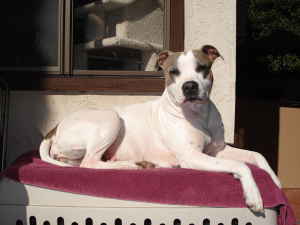
my 4 year old g.s.d. had successful tightrope surgery 90 days ago. complicating matters, both menisci were torn and removed during procedure. still does a little toe dragging when tired but is 90% back. we will likely cut back on the agility trials and flippy-flopper jumping in favor of more linear and less stressful excercise. dr paul henrich, tranquility vet clinic in sussex county, nj did an amazing job. apparently, he has modified or improved dr jamie cook’s procedure to allow the operation to be successful on larger, athletic dogs who may previously have only been candidates for t.p.l.o. “why would you break a bone to repair a ligament ?”
Where are you located?? I have a 3 yar old lab in Michigan, USA who has a ruptured CCL.
I have a 17mos old Boerboel Mastiff that has a torn ccl and have been researching possible alternatives to TPLO – looking for ortho surgeons in the Seattle area that have used this procedure – any ideas?
I have a 15 month old boerboel who we believe ruptured her CCL. what did you end up doing with your dog?
thanks for your help,
Steve
tightrope modified for active, 90 lb. 5 yr yound g.s.d. was successful for owner and canine. when she is whomped, drags the toe downhill a little. why break a bone (tplo) to repair a ligament?
Kate had to have the tightrope removed because it broke inside the bone. It apparently rubbed against a jagged edge and frayed. She was never good from the “get go” she always had a limp. Other people that I have talked to they went with the TPLO and their dogs did fine. Kate had the TPLO last week and already seems to be doing better quicker than when she had the tightrope procedure.
I, too, have a Boerboel Mastiff. Saturday, she began to walk with a limp. My husband took her to the vet this morning and he was advised that she tore her CCL. What did you end up doing for your dog, how did it go, and how much did it end up costing you??
Thanks!
In response to Bev’s post…I live in Bellingham, WA. My 3 year old Boxer just underwent TPLO Surgery. He is into day 7 of his recovery. I did not know about Tightrope procedure prior to his TPLO surgery. My neighbor told me about the Tightrope procedure and recommended his Vetinarian Dr. Ed Sullivan of Bellingham Veterinary, 720 Virginia Street, Bellingham, WA 98225 phone number is: (360) 734-0720.
I spoke to Dr. Sullivan and he gave me some great information. If you are unable to find a Vet in your area who is familiar with the tightrope procedure, I would highly recommend Dr. Sullivan.
I am in Kansas City, MO and My four year old black lab has had a TPLO out at Kansas State University and turned out ok but it was a long road to recovery and still has been. University of Missouri does the tightrope surgery and it is suppose to be better for them and a shorter recovery time.
My dog is in day 10 of his recovery from tightrope surgery. At first he was weight bearing and now he wont put any weight on it all all. Can you tell me how your dog progressed? When was he weight bearing?
Sharon,
I’m sure you already have discovered that the procedure has failed. I have a 70lbs golden retriever who had the tightrope procedure. She never seemed walk without a limp. At approximately 5 months she got up from lying and wasn’t able to bear weight. Now she is scheduled for the TPLO surgery. Not only did the tightrope fail, it also caused her patella tendon to tear.
Our Newfie had TPLO on her right knee last year and it’s been a long recovery for her. Her left knee now needs surgery and someone suggested the tightrope option instead of TPLO. What are your suggestions?
I hope you got my reply. If you can afford it, I think the TPLO is a safer way to spend your money.
I did get your reply Susan. Sorry it took so long to get back. We actually have been in ‘conservative mangagement’ mode with our Newfie. We haven’t had to do any type of surgery at all for the left leg (keep fingers crossed. Our vet has her on glucosamine and anti inflamatories. The warmer weather I think also has helped improve her movement as well as what we have her on. We have the money for the TPLO, we just would rather something less invasive.. but it doesn’t sound like there is anything for her weight and size other than TPLO. The TPLO we did on her right knee was good, but she was already so messed up before the surgery her little feet bones are crooked so she walks funny even after the surgery. Here’s hoping for the best and we’ll see where we get!
Its been 3 weeks and 2 days after Jaspers tightrope surgery. He is walking on his leg slowly. Its 12 weeks just like the TPLO before he is really functional. It cost us $1800. Plus meds which ended up being more like $2500 and we are still going up on the price.
I heard the TPLO was more successful, but more evasive. More of a guarantee for your money. I would probably due the TPLO if I had to do it over again. Too much insecurity and worry.
Jasper is walking with a strong limp. But the personal pressure to me of the scar tissue healing and the muscle securing the leg is too scary. The rest of his life anything could reinjure it. There isn’t much muscle on his back leg and the security is minimal. Tightrope reminds me of orthoscopic surgery with two pieces of stretchy sewing fabric to secure it. Sometimes orthoscopic is good enough.
Its only been 3 weeks. Jasper is walking on all 4 legs 90% of the time. He is happy and on no pain meds or anti-inflammatories. He is in a large pen in the house and leash walked everywhere for the next 9 more weeks.
A positive note for tightrope. It didn’t take much to severe Jaspers ACL, so the knee doesn’t have to be Fort Knox secure for the dog to live a happy life.
So far so good. He is walking.
I create a blog of Jaspers adventure on tightrope surgery. http://www.blogger.com/publish-confirmation.g?blogID=1037835618887070366&postID=8958538686409670590×tamp=1298749170470&javascriptEnabled=true
I hope the owner of this blog doesn’t mind me mentioning it. I thought it might help someone decide.
Hi Sharon – Joey (my Boerboel Mastiff) had the TPLO on her left knee in May and recovery went very well. Then she ruptured her right CCL in Nov and now has passed the 3 mos recovery and is also doing very well. Found a wonderful surgical clinic in north Seattle. They are great and include a PT dept too. Though all procedures and follow up PT is expensive!
Hi Bev,
Where did your Joey have his surgery in north Seattle? Our dog was just diagnosed with tears in both back legs, and we’re looking for options. If we go with TPLO, we want to be sure to find a place with PT support after surgery.
Thanks,
Dina
Dina – I highly recommend Animal Surgical Clinic of Seattle they are wonderful!!!!!!!!!!!!!!!!!!!!! 14810 15th Ave. N.E. Seattle – state of the art surgical team and rehab in one. Joey has had both knees done with the tplo procedure by Dr. Aguila – all the surgeons are amazing. Let me know if you have more questions. My best wishes for you and your pup.
I really recommend the TPLO. We didn’t have a lot of success with tightrope. NOw the dr wants to remove it and due to the TPLO. Can we say $2000 for tightrope, $2000 to remove it and $3000 for TPLO!!!
Sharon, may I ask which vet performed the Tightrope and now wants to do the TPLO? Thank you. Trying to make a decision for my dog’s torn CrCL.
Christine, It was Dr. Justin Harper in Canyon Lake. I wouldn’t recommend tightrope. I think it failed for Jasper. The success rate of TPLO is better.
If you can’t afford TPLO, then just get the torn cartilage removed and follow the recovery steps for TPLO and tightrope. They are the same.
That would be what I would do.
This question is for Bev and/or Janet,
I live in Portland and my boxer has a ruptured cruciate, just wondering what the price range for the procedure was for you ladies in Washington? Here in Portland I’ve been getting quotes for about $3200 to $3800 for TPLO.
Thanks, Lori
I have a nationally ranked canine athlete with a partial tear to his CCR. Any recommendations on what procedure will give the best chance of bringing him back to full performance level?
The majority of the research I read says either method will compromise the dog’s athletic ability but it will bother you more than the dog. Our GSD blew her CCL and tore both menisci and her knee is as good as new as far as she is concerned, but I see how she compensates for the lack of flexibility following a textbook tightrope surgery. Jumps as high and runs the agility course very well but at 5 years old, she is pre-arthritic already. Good luck and keep your expectations moderated.
MIKE
Trying to decide to either have the tplo to tta on my 2 year old english bulldog. she is very acitve and at times acts like her torn rear CCL doesn’t even bother her, but bully’s are known for their very high pain tollerance. Anyone out there have either procedure done on their bully?
Just letting you know that Kate…..my 8 year old golden retriever passed away Aug 22.
I strongly believe that the stress of having 2 surgeries in short amount of time caused her death. Not only did she develop thrombocytopenia (related to pain/stress) she all of sudden developed a cancerous tumor that was inoperable.
Tightrope is not the way to go if your dog is a large breed and active. Kate was 70 lbs. And the vet said she would do great. Again, it failed and then we had to go with the TPLO.
It has been a very hard on me and even after 5 months I still cry when I think of her.
I did get a new addition, another golden retriever named Mya. She is an absolute joy.
Her statue is much stronger, so I am hoping that her ligaments are strong.