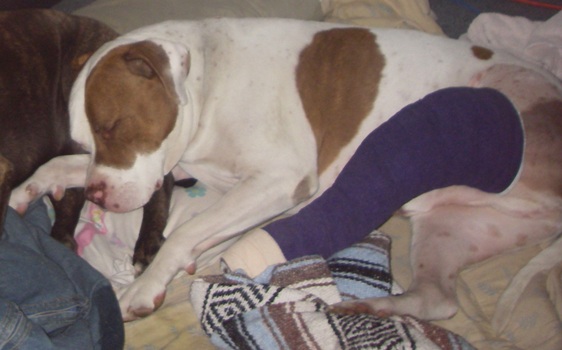
Your dog will be in a lot of discomfort upon their arrival home from surgery. This is especially true if their extracapsular repair was an out patient procedure, and they were released back into your care the same day of the surgery. It is important to follow all the instructions your veterinarian has provided for pain management, as well as antibiotic use, to be sure that your pet has the best recovery possible. Within the first 24 hours after traditional repair, it is normal for dogs to not put any weight on their injured leg. Your dog may have a modified Robert Jones bandage on his limb, further restricting movement, and decreasing the possibility your dog will try to do to too much, too soon.
For the next two weeks (which is the duration of time the bandage will remain on if you dog was fitted with one) your dog will not be putting much weight on the injured limb. They may hold the leg up if they do not have the modified Robert Jones bandage in place, while others will exhibit some toe-touching behavior. After the sutures are removed, at about the 2 week mark, you veterinarian will determine the course of therapy for your dog to proceed with. In many cases your vet will recommend exercise restriction until 4 to 8 weeks, at which point short, 2 to 5 minute walks, can be reintroduced to your pet.
At 6 to 8 weeks you should begin strength training exercises to help your dog rebuild some of the muscle that was lost during the recovery from the extra capsular repair. Your dog will let you know how much exercise they can handle, and you should try to gradually do more and more each day. Water therapy is a great way to regain muscle mass, as it is gentle on the joints and discourages any sort of jerky motion that can be damaging to the joint. Your dog should not be engaging in any rough housing or unsupervised play during this period, as there is an increased potential of injuring your dog’s opposite cranial cruciate ligament.
After 4 to 6 months your dog will be able to return to normal activities without any restriction. The leader line placed in the knee will break at 2 to 12 months post-op, and your dog’s scar tissue will support the knee on its own. Restriction of movement is absolutely key for the successful healing in patients undergoing extra-capsular imbrication repair surgery. Rest will help to encourage fibrous tissue formation and also prevent the premature breakage of the monofilament suture stabilizing the joint during the healing process.
All dogs with CCL injuries will go on to develop some level of arthritis. It is a good idea to have your dog’s knees x-rayed during your yearly veterinary visits to examine the presence of arthritis and determine what type of treatment plan would be best for your pet to make them the most comfortable.
Thanks for this very helpful website! WE have just undergone our 2nd cruciate repair surgery. The first one being when our dog was 9 and now he is 13.5 and has had his second. Thankfully they kept him overnight as the last time I had the same exact experience as you and it broke my heart for him. Luckily, he is an athletic dog (hence the injury!) and the vet expects a good recovery for a dog of his age. Your website helped to remind me of what is in store for us and for him. Bad news for us is that I am due to have our first baby in less that 7 weeks so it will be a bit diffcult around here for a time.
Hope your dog is recovering well and thanks again for your website!
Candy Marcotte
Oakely, Red and Derby Do
Found your site very interesting, full of informative articles, added to my favourites.
About to undergo this with my 2 yr old Am Staff. Think I have made the right decision medically, but if anyone has tips on keeping a youngster calm during his rehab, much appreciated. Our trainer said go all food puzzle, including his mainstream food. Other ideas?
[…] of re-inventing the wheel – I found a great article over at ‘dogkneeinjury.com’ which had all kinds of great information on each surgery type and the post-op care: After 4 to 6 […]
My 7 year old lab had a cruciate ligament repair 13 weeks ago. Everything has been pretty perfect so far, but when I let her have a bit of a run, she bunny-hops instead. It looks so silly. Will this just improve with time? Or is there something else I can do? I thought of doing slow walks mixed with fast walks, and some gradual slow jogs. But is there anything else?
Another thing is that we have no stairs to practice stairs on, we have 2 out front, that I keep getting her to go up and down, but because it’s only the two, she tends to jump them rather than walk them. Any ideas?